
A Fatality and a Close Call

Khan Tengri 7,010m
I chose to attempt Khan Tengri from the North side. It was more technical and objectively more demanding than the Southern route, but it carried a lower avalanche risk. At least, that was the logic at the time. What I would later learn, and eventually witness firsthand, would reshape my understanding of what mountaineering actually demands and how little certainty truly exists in these environments.
I have read and watched enough mountaineering books and documentaries to understand how falls and fatalities unfold. I never expected to witness one on my first expedition. Like most who step into this space, I was aware of the risks long before setting foot on the glacier. Years have passed since that day on Khan Tengri. I have climbed other peaks since, yet the memory of the fall remains as sharp as the ice walls that line the route.
For a long time I questioned whether this film and this story should ever be shared. The incident carries weight and it deserves respect. In the end, film and writing became the only way I knew how to process it. What follows is an attempt to capture the rawness of the experience while preserving the dignity of the climber who lost his life.
Arrival at Base Camp (4,000m)
I was collected in a cramped minivan alongside the rest of the group and one solo traveller, Radek, a Polish climber heading out on his own expedition. We bonded quickly. He was one of the few people on the trip who spoke fluent English, which made the long drive east far more bearable. Before leaving Bishkek, we stopped at the office to hand over the remaining cash payment, then spent the next six hours winding toward Karkara with a quick stop to view Issyk Kul lake. By the time we arrived, exhaustion ha0d set in fully. Bags were weighed early the next morning before we boarded an ageing Soviet helicopter bound for base camp.

Wiring exposed, loose and uncovered, as though assembled by hand without concern for concealment or redundancy. I remember thinking whether this machine would actually fly. We were given a short safety briefing in Russian, which did little to inspire confidence. Sarcasm aside, the rotors turned, the helicopter lifted, and soon the terrain dropped away beneath us. Glacial streams carved through valleys far below, thin threads of water cutting through ice and stone.
Minutes later I stepped onto the glacier in a T shirt and shorts, the cold barely registering as I lifted my eyes toward Khan Tengri. Morning light reflected off its rock faces, beautiful and intimidating in equal measure. The question came uninvited. What have I just committed myself to?

The rest of the day was spent resting, followed by a late afternoon skills rehearsal ahead of our acclimatisation push to Camp 1 the next morning.
Camp 1 (4,600m) and the First Setback
The initial climb to Camp 1 felt strong. My body responded well, and confidence came easily. However, that confidence disappeared quickly on the return to base camp after a severe stomach illness left me weak and dehydrated.

Camp 1 to Camp 2 (5,500m)
When rotations resumed, I trailed behind the group back up to Camp 1, running on little more than stubbornness. A team of three Germans arrived at base camp whilst I was down and had also ventured up for their acclimatisation hike. They spoke good English and quickly became easy to get along with. We played Uno in the snow, huddled over a deck of playing cards while avalanches thundered down the North face of Khan Tengri below us. It struck me later that this expedition introduced me to more international friendships than any other journey. In the months and years that followed, I would cross paths with many of them again. Exploring the Dolomites and climbing Grossglockner in Austria. Couchsurfing on Eike’s couch in Munich before a day trip to climb Germany’s highest peak, Zugspitze and reuniting in Switzerland years later.

The following morning, I clipped into the fixed lines early and began ascending up to Camp 2. The terrain steepened through rock bands, ice walls and exposed ridgelines. Eight hours in, my energy vanished. Altitude pressed in, clouds darkened, and thunder rolled across the range. I pushed through the final pitches searching for shelter. Too late. Snow blasted sideways, visibility collapsed, fingers froze solid.
I had staggered into Camp 2 as the stormed peaked, exhausted and drained. The following morning was eerily calm. Not a single gust of wind disturbed the tent. Overnight snowfall had accumulated heavily, forcing us to break trail during an afternoon acclimatisation push partway toward Camp 3. By late afternoon we reached the rock band below Chapaev Peak before descending back to base camp the following morning for some much needed recovery.

I met an American climber, Kaleb at base camp upon my return from camp 2. He had not been as fortunate on his arrival to basecamp. His helicopter was forced to abort mid flight due to rising winds and an escalating storm. They landed in the middle of nowhere and spent the night exposed, flying into base camp the following morning with little more than basic food rations.
In hindsight, it was far better to have landed and survived than to become another statistic, another crash site scattered across the mountains, especially knowing that the same helicopter model had gone down in the same region years earlier. Our timing at base camp worked in our favour. A sustained cluster of severe weather battered the mountain in the days that followed, effectively shutting everything down. We woke to fresh snow coating the tents and the glacier beneath them, a winter wonderland.

Camp 2 to Camp 3 (5,900m)
High winds delayed our departure until mid morning. Unpredictable weather delayed our departure until late morning, a decision that should likely have ended the attempt before it began. Moving as a group meant matching the pace of the slowest climber.
The initial slope demanded trail breaking, every step sinking deeper than the last. Fatigue compounded with altitude.
At the exposed knife ridge we waited for the wind to ease. When it did, I moved carefully, concentrating on balance. Halfway across, the snow collapsed beneath my foot. I slid instantly, too fast to self arrest. The fixed line caught me.
Relief came first. Then frustration. My right crampon had dislodged. I climbed back onto the ridge using two functioning limbs, reset the crampon, and finished the crossing. Sitting astride the ridge, I muttered a quiet reprimand to myself and waited until my nerves settled.

The discrepancy in ability was significant, and we lost valuable time, energy, and food. By the time we reached the rock band again, sunset was approaching and the choice was made to turn around just 100m short of Chapaev Peak. I remember thinking how unnecessary it all felt. Why leave at eleven when seven was clearly the only rational option.
Communication with the local guides was basic. Their English was limited, while the Nepalese Sherpas assisting as the rope fixing team, spoke far more clearly. We got along easily and talked often. Half joking, half serious, we spoke about climbing together in Nepal one day. Around us, frustration simmered as the group vented about the lack of organisation across the expedition. At Camp 2, I shared a shared a tent with Wangdu Sherpa. In passing, I asked him how many times 8,000m peaks he had climbed. He answered calmly and casually several. I laughed. Watching him move uphill was something else entirely. He ran straight up the slope, choosing the most direct line, moving with a speed and ease that made the terrain look irrelevant, his acclimatation aided with constant Russian cigarettes.
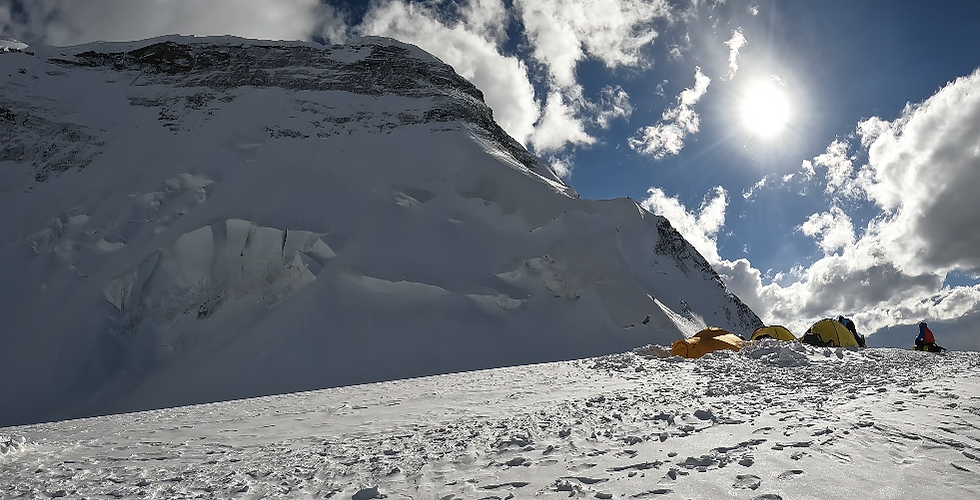
Second Attempt Camp 2 to Camp 3
Out of frustration, two Sherpas chose to turn back toward base camp. They accompanied the climbers who no longer had the strength or health to make another attempt toward Camp 3, bringing their expedition to a premature close.
Only two of us had decided to make another summit attempt, this time committing to an earlier departure in the morning. We moved faster this time, reaching our previous turnaround point an hour earlier. Near the second rock wall, an unfamiliar group appeared above us traversing the mountain from the South. We waited as they prepared to descend.
As they began to rappel, fixed lines tangled. Once clear, I moved quickly, noticing another climber above me. I assessed the slope and decided to pitch my line to the right. Left foot kick. Right foot kick. Jumar. Axe. The rhythm settled in.

Then a scream.
I looked up to see a silhouette tumbling toward me, accelerating. The mountain’s slope deflected the falling body and debris just to my left. Time slowed. Snow blasted my face as I tried to understand what I was seeing. Then silence.
Out of earshot.
I froze, hands on my helmet. Had the rope snapped. Seconds passed. Then minutes. The summit no longer mattered. I checked the line again and again before rappelling back to safety.

I watched the rescue team below recover the body from the knife edge above. They roped together through crevassed terrain, broke trail, and shovelled snow to create a manageable path. The intention was simple and brutal. Get the climber back to Camp 2. The following morning I left early, knowing the expedition was effectively over for me. The team that had lost their climber wrapped the body in a redundant tent. What would normally be a four to five hour descent from Camp 2 took them the entire day and night. They moved slowly and deliberately through the rockbands, ridgelines, and technical ground. Seventeen hours later, head torches appeared far below, marking their arrival at base camp. Vodka shots followed. Grief expressed quietly. The Soviet helicopter scheduled to return other climbers to the civilisation instead made a single flight carrying the body out.

Aftermath and Reflection
I had consumed countless stories of accidents before this expedition. None prepared me for witnessing one. A small mistake in an unforgiving environment carried fatal consequences.
The reality of what happened continues to settle in layers rather than all at once. What I do know is that the experience sharpened my understanding of risk. The skills and judgement forged on this mountain now sit alongside a deeper respect for how quickly control can disappear. This is not a story of summits. It is a record of consequence.
Mountains carry a quiet majesty. They are daunting, intimidating, and often frightening, yet undeniably beautiful. Jagged ridgelines, sharp summits, and the soft glow of first light reflecting off ice and stone create a pull that is hard to explain. But mountaineering strips that romance away quickly. When confidence outpaces placement, consequences arrive without hesitation, and they are often fatal.
That season offered only a narrow margin for success. Within the already short climbing window, there were few summit pushes and only a handful of successful ascents. The weather was harsh and unforgiving, granting brief moments of opportunity before closing in again, leaving little room for endurance, error, or second chances.

Safety Note
Khan Tengri is a highly technical 7000 metre peak. Conditions change rapidly and hazards are persistent. This account is not instruction and should not be used as guidance. High altitude climbing carries inherent risk, including death, even when protocols are followed.


Comments